
Deciding whether to build a brand-new home from the ground up or undertake a major renovation is one of the biggest financial and lifestyle commitments you will ever make. As we navigate the construction landscape in 2026, homeowners and developers alike are weighing shifting material prices, skilled labor rates, and evolving energy codes against their long-term property goals.
Is a major gut renovation still the budget-friendly shortcut it used to be? Or have rising labor costs and structural complexities closed the gap between remodeling and building new?
At Farris General Contracting, we guide residential clients and developers through both paths every day. In this comprehensive guide, we break down current 2026 costs, labor-versus-material splits, timelines, and return on investment (ROI) to help you decide which option truly costs less for your project.
1. The 2026 Cost Reality Check: Per-Square-Foot Breakdown
To understand which option costs less, we first need to examine current baseline numbers for 2026. While exact figures vary by region, national averages and builder benchmarks provide a clear picture of what to expect.
New Construction Costs in 2026
Building new gives you a blank slate, but it also requires covering every single component from foundation to roof peak.
- Production & Semi-Custom Homes: Typically range from $175 to $320 per square foot, depending on finishes and location.
- Custom Homes: Generally range from $300 to $600+ per square foot, reflecting bespoke architectural designs, specialized engineering, and premium finishes.
- Total Project Investment: Most single-family custom builds range from $350,000 to over $800,000+, excluding the cost of the land itself.
Major Renovation Costs in 2026
Whole-home renovations and major remodels are traditionally viewed as the more economical choice because you are preserving the existing foundation and framing.
- Non-Structural / Cosmetic Whole-Home Remodels: Often range from $100 to $200 per square foot, focusing on kitchens, bathrooms, flooring, and aesthetic updates.
- Structural & Gut Renovations: When you start moving load-bearing walls, replacing out-of-code electrical systems, and upgrading plumbing, per-square-foot costs climb rapidly to $175 to $350+ per square foot.
- High-End Historic or Complex Remodels: Can reach $350 to $500+ per square foot, matching or even exceeding the cost of new construction.
2. When Renovation is Actually Cheaper (and When It Isn't)
The rule of thumb for decades has been that remodeling costs roughly 20% to 40% less per square foot than building new. In 2026, that math still holds true: under the right conditions.
Renovation Wins on Cost When:
- The Core Structure is Sound: Your foundation, subfloor, and main framing are stable and free of rot or structural settlement.
- The Layout Works: You are updating finishes, expanding a kitchen, or refreshing bathrooms without moving major load-bearing walls or altering the roofline.
- Systems are Up-to-Date: Electrical panels, plumbing supply lines, and HVAC ductwork require updates rather than total replacement.
The 60-70% Rule: When New Construction Wins
If your major renovation estimate starts creeping past 60% to 70% of the cost of building an equivalent new home, you need to pause and look at a custom build. Why?
When contractors open up walls in older homes, they frequently encounter hidden surprises: knob-and-tube wiring, asbestos, deteriorated plumbing, or sagging headers. Remediation adds significant labor hours. Furthermore, adding square footage via a massive home addition often costs just as much per square foot as building a brand-new wing from scratch.
Learn more about how our team approaches transformations by visiting our dedicated pages on remodels and custom builds.
3. Labor vs. Material Splits in 2026
One of the most overlooked differences between new construction and major renovation is how capital is allocated between labor and materials.
- New Construction (Approx. 40% Labor / 60% Materials): New builds benefit from standardized construction sequences. Framing crews, drywallers, and installers can work efficiently in wide-open spaces. Material purchasing can be optimized through volume orders, though persistent tariffs and baseline commodity prices remain elevated in 2026.
- Major Renovation (Approx. 70% Labor / 30% Materials): Remodeling is inherently labor-intensive. Skilled tradespeople spend hours delicately demoing old materials, matching historic finishes, working around tight spaces, and tying new electrical or plumbing into legacy systems.
Because skilled labor shortages continue to drive up wage rates across the trades, the labor-heavy nature of major renovations can quickly erode projected savings.
4. Timelines, Hidden Expenses, and Opportunity Cost
Money is not the only currency when undertaking a construction project; time and predictability matter immensely.
Timeline Comparison
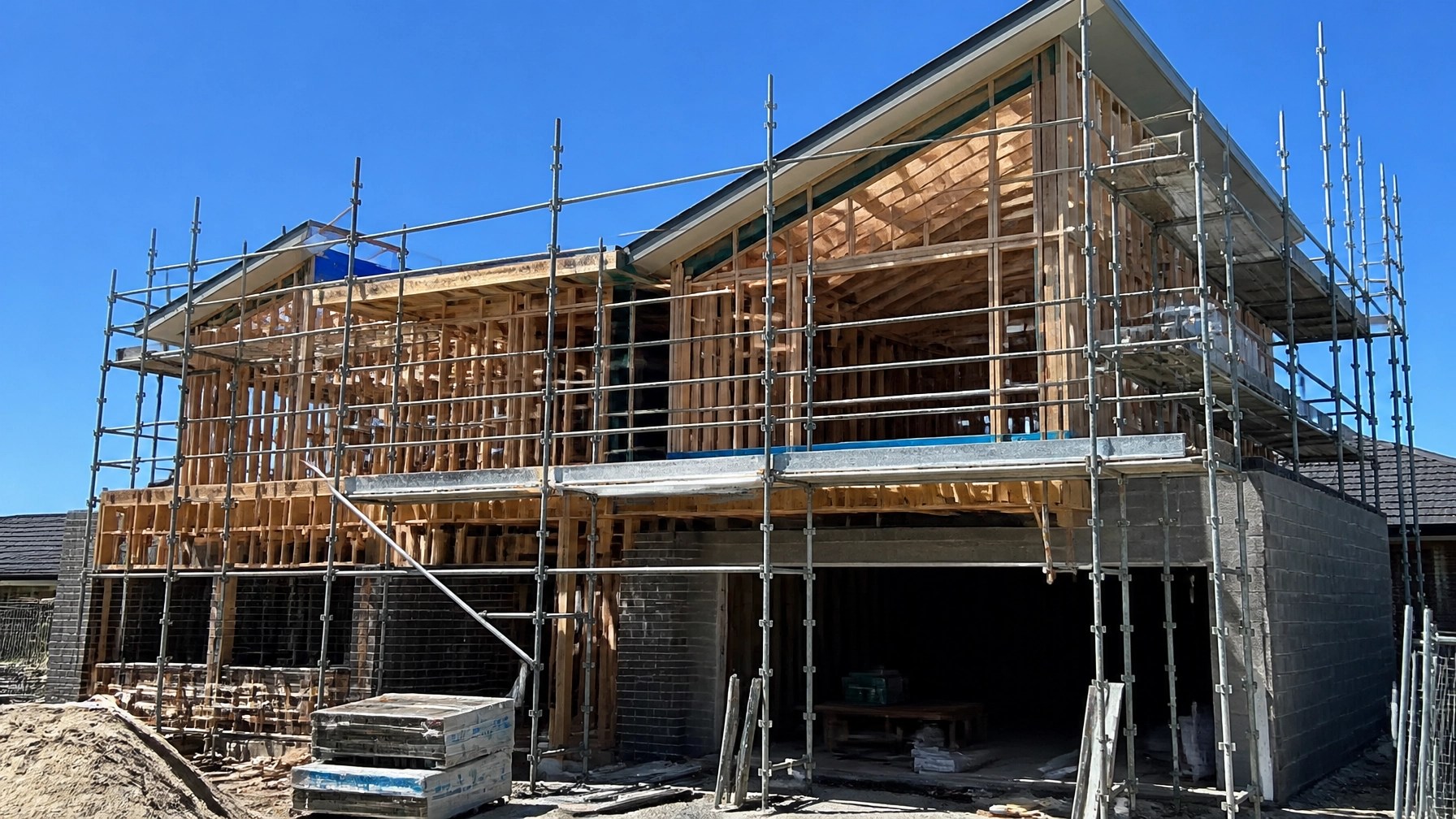
- New Construction: Typically runs 6 to 14 months, depending on custom complexity and site preparation. While permitting and utility hookups take time, the workflow is linear and predictable once ground is broken.
- Major Renovation: Often runs 4 to 9 months. However, renovations carry a much higher risk of schedule overruns. Discovering water damage behind a wall or waiting on custom parts to fit non-standard framing dimensions can stall a project for weeks.
Hidden Expenses to Anticipate
- Contingency Funds: For new construction, a 5% to 10% contingency is standard. For major renovations, we strongly advise a 15% to 20% contingency fund to account for unforeseen structural conditions.
- Temporary Living Costs: If you cannot live in your home during a major gut renovation, factor in several months of rental housing or storage unit fees, which add thousands of dollars to your out-of-pocket total.
5. Energy Codes, Efficiency, and Long-Term ROI
Energy efficiency standards have tightened significantly, impacting both building paths.
- New Construction Advantage: Building a home from scratch allows you to integrate high-performance insulation, advanced HVAC zoning, smart home automation, and solar-ready infrastructure seamlessly. The resulting utility savings and long-term durability are unmatched.
- Renovation Upgrades: While major renovations give you the chance to upgrade insulation and windows, working within an existing building envelope sometimes limits how airtight or energy-efficient a home can become compared to a modern code-compliant build.
When evaluating ROI, a well-executed custom build in a desirable neighborhood or a smart, targeted whole-home renovation both yield strong equity gains: provided you do not over-improve for your neighborhood's price ceiling.
Making the Right Choice for Your Project
So, which one actually costs less in 2026?
- Choose Major Renovation if your project stays primarily non-structural, preserves a sound foundation and framing system, and keeps total scope under 60% of new-build value.
- Choose New Construction if your existing structure requires extensive gutting, foundation repair, and major layout overhauls, or if you want absolute control over your floor plan and long-term energy performance.
Navigating this decision doesn't have to be overwhelming. Whether you are planning a transformative home addition or embarking on a ground-up commercial or residential project, having an experienced partner makes all the difference.
Explore our portfolio at our work, read more about our philosophy on our about us page, or contact us today to schedule a consultation with the experts at Farris General Contracting. Let's bring your vision to life!
